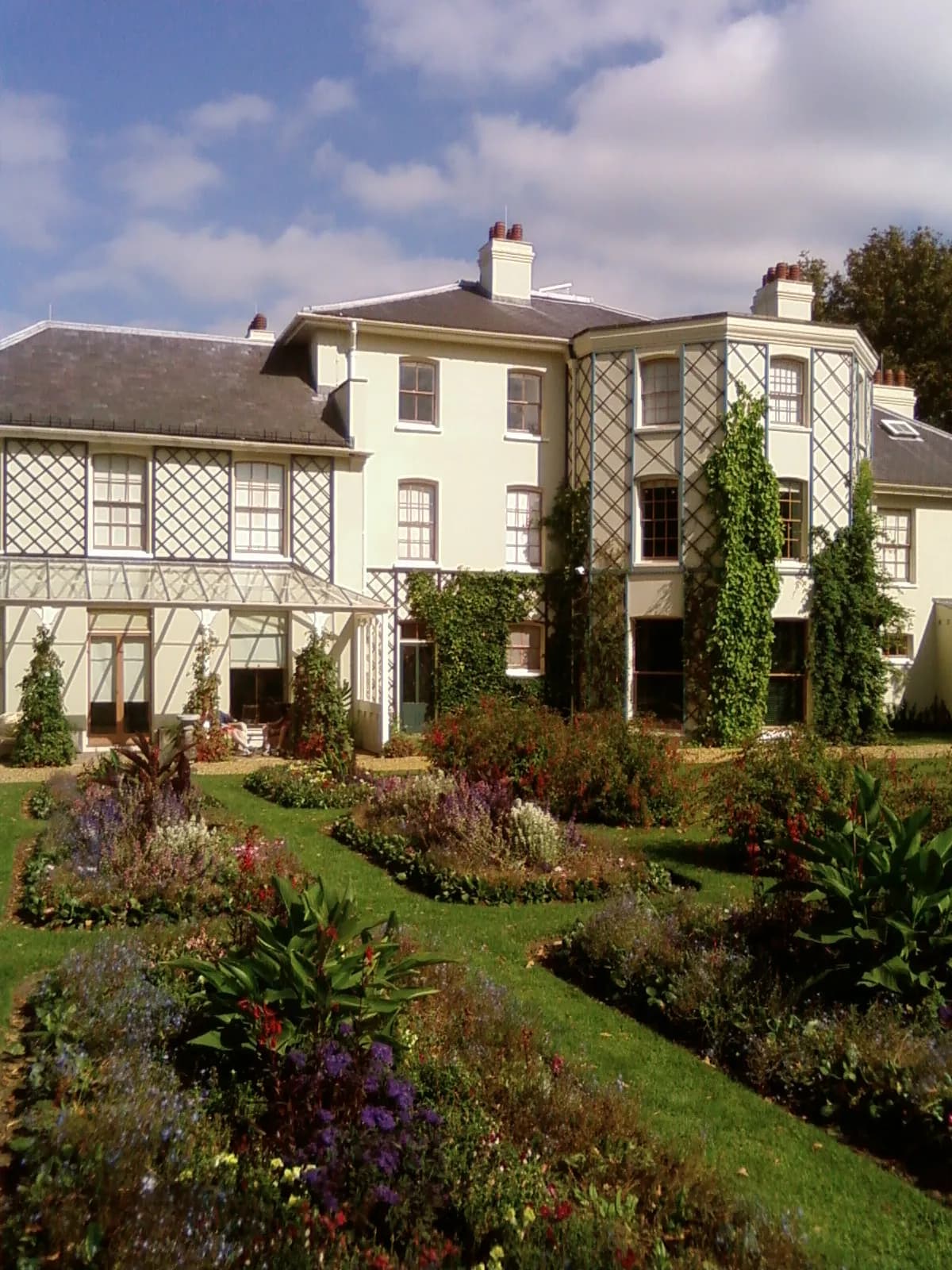
Down House stands on Luxted Road in Downe, a quiet Kent village that now lies within the London Borough of Bromley. For forty years it served as the family home of Charles Darwin, the naturalist whose work would fundamentally alter humanity's understanding of life on Earth.
A Georgian House in the Kent Countryside
The house itself dates to the late eighteenth century, built in the Georgian style that characterises much of the architecture in this corner of Kent. It sits approximately one quarter of a mile south of Downe village, occupying a position that offered Darwin both rural seclusion and enough proximity to London to maintain the correspondence upon which his research depended.
Darwin's Arrival and Family Life
Darwin moved to Down House in 1842, seeking a permanent home where he could raise his growing family whilst pursuing his scientific work. The location proved ideal; the surrounding countryside provided ample material for his observations, whilst the house itself offered the space he needed for his expanding household and his studies.
He would remain at Down House until his death in 1882. The memorial tablet fixed to the exterior wall records this period plainly: "Here Darwin Thought and Worked for Forty Years and Died 1882."
The Study Where 'On the Origin of Species' Took Shape
The ground-floor study at Down House served as the centre of Darwin's intellectual life. It was here that he developed the arguments that would eventually appear in "On the Origin of Species," published in 1859. The room remains substantially as he left it, with his writing desk, chair, and the various scientific instruments he employed in his research.
Visitors can see the modest conditions under which one of the most influential works in scientific literature was produced. The study lacks grandeur; it is a working room, arranged for practical purposes rather than display.
The Sandwalk and Experimental Grounds
Beyond the house itself, the grounds played an essential role in Darwin's working methods. He established what became known as the Sandwalk, a circuit through the grounds that he walked daily whilst thinking through his theories. This path allowed him to combine physical exercise with the contemplative work of developing his arguments.
The gardens and grounds also served as experimental spaces. Darwin conducted extensive botanical research on the property, investigating plant behaviour, pollination mechanisms, and the action of earthworms in soil formation. His greenhouse, which visitors can still see, supported these investigations.
The House Today
Down House now operates as a museum managed by English Heritage. The interior has been restored to reflect its appearance during Darwin's residence, drawing upon contemporary descriptions and family records. Visitors can tour the ground-floor rooms, including the study, drawing room, and dining room, as well as the upper floors where the family's private quarters were located.
The gardens and grounds have been restored to reflect their nineteenth-century character, allowing visitors to walk the Sandwalk and see the sites of Darwin's botanical experiments. The greenhouse has been reconstructed based on historical evidence.
Local Significance for Bromley
For residents of the London Borough of Bromley, Down House represents a connection to one of the most consequential intellectual developments in modern history. The theories developed within this house have influenced biology, medicine, agriculture, and conservation worldwide.
The house also serves as a reminder of the scientific culture that existed in this corner of Kent during the nineteenth century. Darwin's neighbours included other prominent figures, and the area became something of a retreat for those seeking to escape London whilst maintaining connections to the scientific establishment.
Visiting Information
Down House is located at Luxted Road, Downe, BR6 7JT. The property is open to the public with admission fees supporting the maintenance of the house and grounds. Visitors should consult the English Heritage website for current opening hours and ticketing information.
The house is accessible by public transport from Bromley town centre, with bus services connecting to Downe village. The walk from the village to the house follows the same lanes Darwin would have used during his residence.