Herbert George Wells was born on 21 September 1866 above a china shop on Bromley High Street. The modest surroundings of Atlas House, at 162 High Street, would prove the unlikely cradle for one of literature's most expansive imaginations.
The Wells Family Shop
Joseph Wells, Bertie's father, was a professional cricketer for Kent County Cricket Club who combined his sporting career with running a small shop selling china and sporting goods. The family occupied the premises above the shop, a typical Victorian arrangement that placed the Wells family at the heart of Bromley's commercial life. Joseph had achieved cricketing fame in 1862 when he became the first bowler to take four wickets in four balls in a first-class match. His wife, Sarah Neal, had previously worked as a domestic servant before marriage.
The shop struggled financially. Stock was described as old and worn out, and the location was poor. The family relied heavily on Joseph's cricket income, a precarious foundation that would soon crumble.
Early Education and the Accident That Changed Everything
Young Bertie's formal education began at Mrs Knott's Dame school at 8 South Street, where he learned to read and write. A marble plaque still marks the building today. In 1874, aged eight, he enrolled at Thomas Morley's Commercial Academy at 74 High Street, a private school founded in 1849.
The education was erratic, focusing on copperplate handwriting and trade sums rather than the classical curriculum of more prestigious establishments. Yet it was during his time at Morley's that a defining incident occurred. In 1874, Wells broke his leg and was confined to bed. His father brought him books from the local library, sparking a lifelong devotion to reading that would prove more formative than any classroom instruction.
The Shop Fails, the Family Scatters
Disaster struck in 1877 when Joseph Wells fractured his femur, ending his cricket career and with it the family's main source of income. The shop failed, and the family could no longer support themselves. In 1879, aged thirteen, Bertie left Bromley to begin a draper's apprenticeship at Hyde's Drapery Emporium in Southsea. He later described these years as the most miserable of his life.
The experience of financial insecurity, of respectable poverty in a town transforming from rural market centre to London commuter suburb, would leave deep impressions on Wells's imagination.
Bromley Transformed: The Railway Arrives
When Wells was born, Bromley was already changing. The railway had arrived at Shortlands in 1858, triggering rapid expansion that turned the ancient market town, chartered in 1158, into a destination for London commuters. Outlying districts like Bickley developed with villas for the metropolitan middle classes.
This tension between the rural past and urban future, between the Kentish market town and the spreading tentacles of London, became a recurring theme in Wells's work.
Bromley in Fiction: Bunhill and Bromstead
Wells never wrote directly about Bromley under its own name. Instead, he transmuted his hometown into fictional settings that allowed him to examine its social dynamics with critical distance. In "The War in the Air" (1908), he referred to Bromley as "Bunhill." In "The New Machiavelli" (1911), it became "Bromstead."
His descriptions were not always flattering. At one point he described Bromley as a "morbid sprawl of population." Yet an early unsigned article for the Pall Mall Gazette expressed satisfaction at being born in "an earlier, more rural Bromley," suggesting a complex nostalgia for the town of his childhood.
The social realism of novels like "Kipps" (1905) and "The History of Mr Polly" (1910) drew heavily on his experiences of lower-middle-class life in Victorian Bromley. The sense of constrained ambition, of talent trapped by circumstance, reflects the young Wells's own frustrations in a town where his family's social standing was precarious.
An Ambivalent Legacy
Despite his international fame as the author of "The Time Machine" (1895), "The War of the Worlds" (1898), and "The Invisible Man" (1897), Wells maintained a complicated relationship with his birthplace. When offered the Freedom of the Town, he refused, stating: "Bromley has not been particularly gracious to me nor I to Bromley and I don't think I want to add the freedom of Bromley to the freedom of the City of London and the freedom of the City of Brussels – both of which I have."
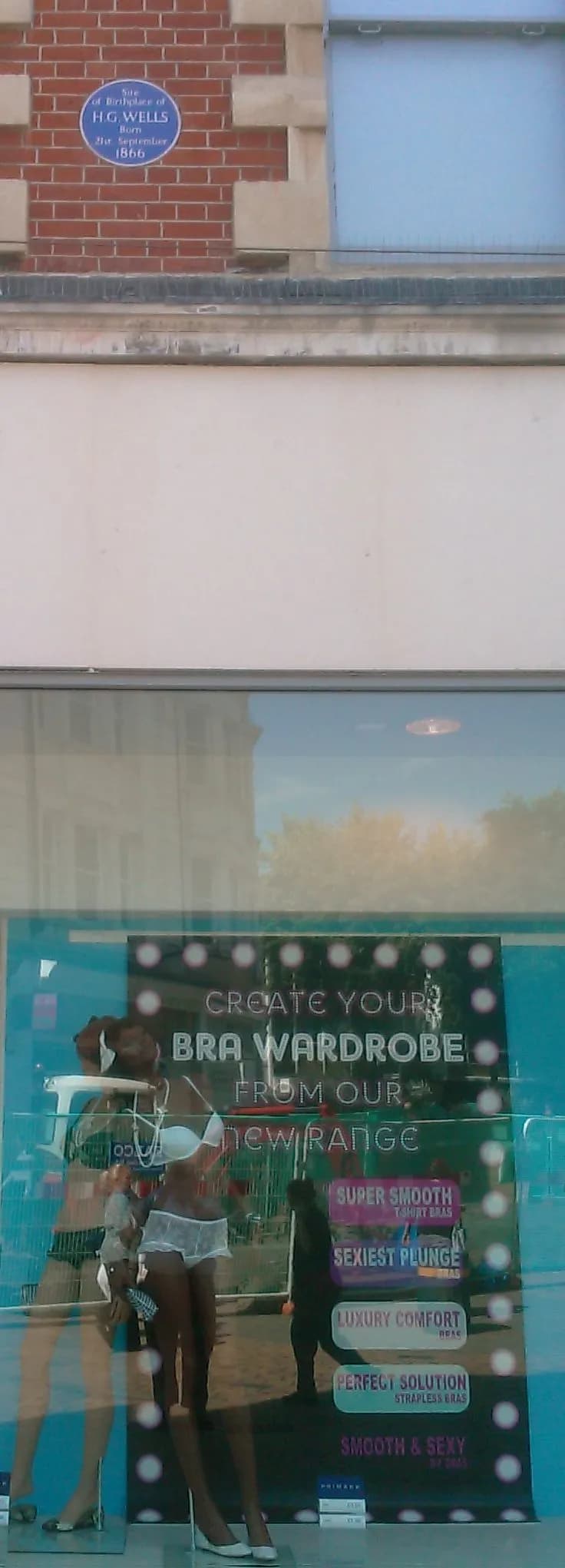
The town, however, has been more generous in its retrospective embrace. An English Heritage blue plaque marks his birthplace in Market Square, now on the wall of a Primark store. The plaque at 8 South Street commemorates his early education. Until its demolition in 2017, the H.G. Wells Centre at Masons Hill housed the Bromley Labour Club, a fitting tribute to Wells's socialist politics.
What Remains Today
Visitors to Bromley can still trace Wells's childhood geography. The High Street has transformed almost beyond recognition, but the location of Atlas House remains marked. The Market Square features a wall painting, repainted in 2005, depicting the evolutionary sequence of Homo sapiens from Darwin's "Origin of Species" – a visual reference to Wells's scientific humanism and his training under T.H. Huxley at the Royal College of Science.
The cricket connection continues at Bromley Cricket Club, founded in 1820, where evidence of cricket in the town dates back to 1735. Joseph Wells helped establish the club's early reputation, and his son's subsequent literary fame ensured that Bromley would be remembered as something more than a suburban waypoint.
Wells left Bromley at thirteen, but the town never left him. In his imagination, it became the stage upon which he dramatised the great transformations of the modern age: the arrival of the machine, the rise of suburbia, the aspirations and frustrations of the provincial middle class. The father of science fiction was, in origin, a shopkeeper's son from Bromley High Street – and the tension between those two identities fuelled one of the twentieth century's most remarkable literary careers.